
There’s no fixed upper age limit for dental implants. An 80-year-old with stable health, good jaw support, and controlled gum disease may be a stronger candidate than a 55-year-old with uncontrolled diabetes, heavy smoking, and active periodontal infection.
The real question is whether your mouth and overall health can support surgery and healing. Your dentist will look at bone volume, gum health, medications, bite forces, hygiene habits, and whether scans show enough jaw support for single-tooth, multiple-tooth, or full-arch implants.
- Best for long-term chewing and fixed teeth: dental implants, if bone and healing risk are acceptable.
- Best for lower cost and simpler treatment: removable dentures.
- Best when several teeth are missing but surgery isn’t ideal: partial dentures or bridges.
Is There an Age Limit for Dental Implants?
Dentists don’t use a birthday as the cutoff for dental implant treatment. An active, healthy 80-year-old with stable medical conditions and enough jawbone support may be a better candidate than a 45-year-old with uncontrolled periodontal disease, heavy smoking, and poor healing.

What matters is whether your body and mouth can support surgery, healing, and osseointegration, the process where the implant fuses with the jawbone. A dental implant is usually a titanium post, though zirconia implant options exist, topped with an abutment and crown. For that system to last, the surrounding bone and gums have to be healthy enough to hold it.
You’re more likely to be a good candidate if:
- Your gum health is stable, with gingivitis or periodontal disease treated first.
- Your jawbone has enough height, width, and density to support the implant.
- Your medical conditions are controlled well enough for oral surgery.
- You can maintain daily oral hygiene around the implant.
- You understand that healing takes time and follow-up visits matter.
So, is 80 too old for dental implants? Not automatically. Is 70 too old? No. There isn’t a specific age when you “should not” get implants. Treatment is usually delayed or reconsidered when the risk of implant failure is high because of uncontrolled disease, active infection, severe untreated bone loss, or medications and health conditions that need medical clearance first.
The better question isn’t “Am I too old?” It’s “Can my bone, gums, health, and habits support a stable implant?”
What Matters More Than Age
Your jawbone and gums do more to predict implant success than the number of candles on your birthday cake. A healthy 78-year-old with stable bone and well-controlled gums may be a better candidate than a 52-year-old with active periodontal disease and heavy plaque buildup.
Bone Density and Jaw Health
A dental implant needs enough jawbone to hold the implant post securely while it heals. Most implants use a titanium post, though a zirconia implant may be considered in selected cases. After placement, the post has to fuse with the bone through osseointegration before it can reliably support an abutment and crown.
Bone loss doesn’t automatically prevent dental implants, but it changes the plan. If the jawbone is too thin, too short, or too soft, your dentist may recommend a bone graft before implant placement. For upper back teeth, a sinus lift may be needed if the sinus sits too close to the planned implant site.
This is where imaging matters. A panoramic X-ray gives a broad view of missing teeth, bone height, and anatomy. A cone beam CT scan is more detailed and helps measure bone width, nerve position, sinus location, and implant angles. That scan can show whether you’re ready for a standard implant, need grafting first, or should consider a different option such as a fixed bridge or partial denture.
Low bone density, osteoporosis, or long-term edentulism can make planning more complex, but they don’t always rule implants out. The key question is whether the available bone can support the load of chewing without raising the risk of implant failure.
Gum Disease and Oral Hygiene
Implants need healthy gums around them, just like natural teeth need healthy gums around their roots. If you have gingivitis, the issue may be reversible with professional cleaning and better home care. If you have active periodontal disease, implant treatment usually needs to wait until the infection is controlled.
Why the delay? Bacteria and inflammation can damage the tissues that hold an implant in place. Around implants, this problem is called peri-implantitis, and it can lead to bone loss, bleeding, pocketing, looseness, and eventual implant failure.
Good candidates don’t need perfect mouths, but they do need a realistic maintenance routine:
- Brush thoroughly twice a day
- Clean between teeth or implants with flossing aids, interdental brushes, or a water flosser
- Treat dry mouth if it’s increasing plaque buildup
- Wear a night guard if bruxism is putting heavy force on teeth or implants
- Keep regular hygiene visits with a general dentist, periodontist, or implant-focused provider
So if you’re asking, “Can I get implants if I have gum disease?” the practical answer is yes, sometimes, but not while the disease is active and uncontrolled. Stabilize the gums first, then reassess implant candidacy.
Who May Need Extra Evaluation Before Treatment
Chronic Conditions and Medications
Some patients don’t need a “no” on implants; they need “not yet” or “only with clearance.” That’s common for older adults managing diabetes, osteoporosis, heart disease, autoimmune conditions, or cancer-related treatment histories.
The key question is whether your body can heal predictably after the titanium post, or sometimes a zirconia implant, is placed in the jawbone. Implant success depends on osseointegration, where bone bonds to the implant surface. Anything that slows healing, raises infection risk, or affects bone metabolism deserves a closer look.
Your general dentist, periodontist, oral surgeon, or prosthodontist may ask for medical clearance if you have a chronic condition, complex medication history, or other health factor that could affect healing.
- Diabetes, especially if blood sugar has been hard to control
- Heart disease, recent cardiac procedures, or a history of stroke
- Osteoporosis, particularly if you’ve used certain bone-modifying medications
- Immune suppression from medications or medical conditions
- A history of radiation therapy to the head or neck
- Bleeding disorders or complex clotting risks
- Severe dry mouth that increases decay and plaque buildup
Medication review matters just as much. Blood thinners don’t automatically rule out implant surgery, but your dental provider needs to coordinate with your physician before changing or pausing anything. Don’t stop anticoagulants on your own. Immunosuppressants, long-term steroids, some osteoporosis medications, and certain cancer therapies may also affect healing or bone response.
So what does this mean in practice? A healthy 80-year-old with stable blood pressure and good oral hygiene may be a stronger candidate than a 55-year-old with uncontrolled diabetes and active periodontal disease. Age is background information. Stability, healing capacity, and surgical risk drive the plan.
Treatment may be delayed if a condition is uncontrolled, if a medication plan needs coordination, or if infection is present. But delay isn’t the same as disqualification. Once your medical and dental teams agree the risk is manageable, implant planning can often move forward.
Smoking, Healing, and Surgical Risk
Smoking is one of the biggest lifestyle factors dentists review because it can interfere with blood flow, gum healing, and osseointegration. It also raises the risk of peri-implantitis, the implant-related inflammation that can lead to bone loss around an implant.
Can smokers get dental implants? Sometimes, yes. But the risk conversation needs to be honest. A smoker may be asked to stop before surgery and avoid smoking during the healing period, especially if bone grafting, a sinus lift, or multiple implants are planned. The longer and heavier the smoking history, the more carefully the team will assess the case.
Extra evaluation may include a periodontal exam, oral hygiene review, and imaging such as a panoramic X-ray or cone beam CT scan to check jawbone volume and bone density. If the scan shows thin bone, infection, or poor support, the provider may recommend treating disease first, improving hygiene, or discussing alternatives before placing implants.
The practical dividing line is this: controlled health risks can often be planned around, but active infection, heavy smoking without willingness to pause, or unstable medical conditions can increase implant failure risk enough that treatment should wait. That pause protects the final result, whether you’re replacing one tooth or planning a larger restoration later.
Can Older Adults Get Full-mouth Implants?
Yes, older adults can get full-mouth implants, including people in their 70s or 80s, if their jawbone, gum health, healing capacity, and medical profile support surgery. Full-mouth treatment is often used for edentulism, severe tooth loss, or failing teeth that can’t predictably be saved.
- All-on-4: A full-arch restoration supported by four dental implants, often chosen when bone is limited in certain areas.
- All-on-6: Similar concept, but with six implants for added support when anatomy allows.
- Implant-supported overdenture: Snaps onto implants but can be removed for cleaning.
- Fixed full-arch bridge: Stays in place and feels closer to natural teeth, but costs more and requires careful hygiene.
Can you have all your teeth pulled and get implants? Sometimes, yes. But it shouldn’t be treated like a same-day shortcut. A general dentist, oral surgeon, periodontist, or prosthodontist needs to decide which teeth are hopeless, whether infection is present, and whether immediate implants are safe. In some cases, teeth are removed, implants are placed, and a temporary restoration is attached the same day. In others, bone grafting, healing, or gum treatment comes first.
Full-mouth implants are usually most worth considering when removable dentures slide, limit chewing efficiency, affect speech, or cause sore spots. They can improve comfort and quality of life, but they also require surgery, a healing period, maintenance visits, and excellent cleaning around the implants to reduce peri-implantitis risk.
The best candidates aren’t simply “older adults who want fixed teeth.” They’re patients whose health risks are controlled and whose treatment plan matches their bone, bite, budget, and ability to maintain the restoration long term.
Dentures Vs. Dental Implants for Seniors
For many seniors, the main question is which option offers enough stability, comfort, chewing ability, speech confidence, and manageable maintenance for your situation.
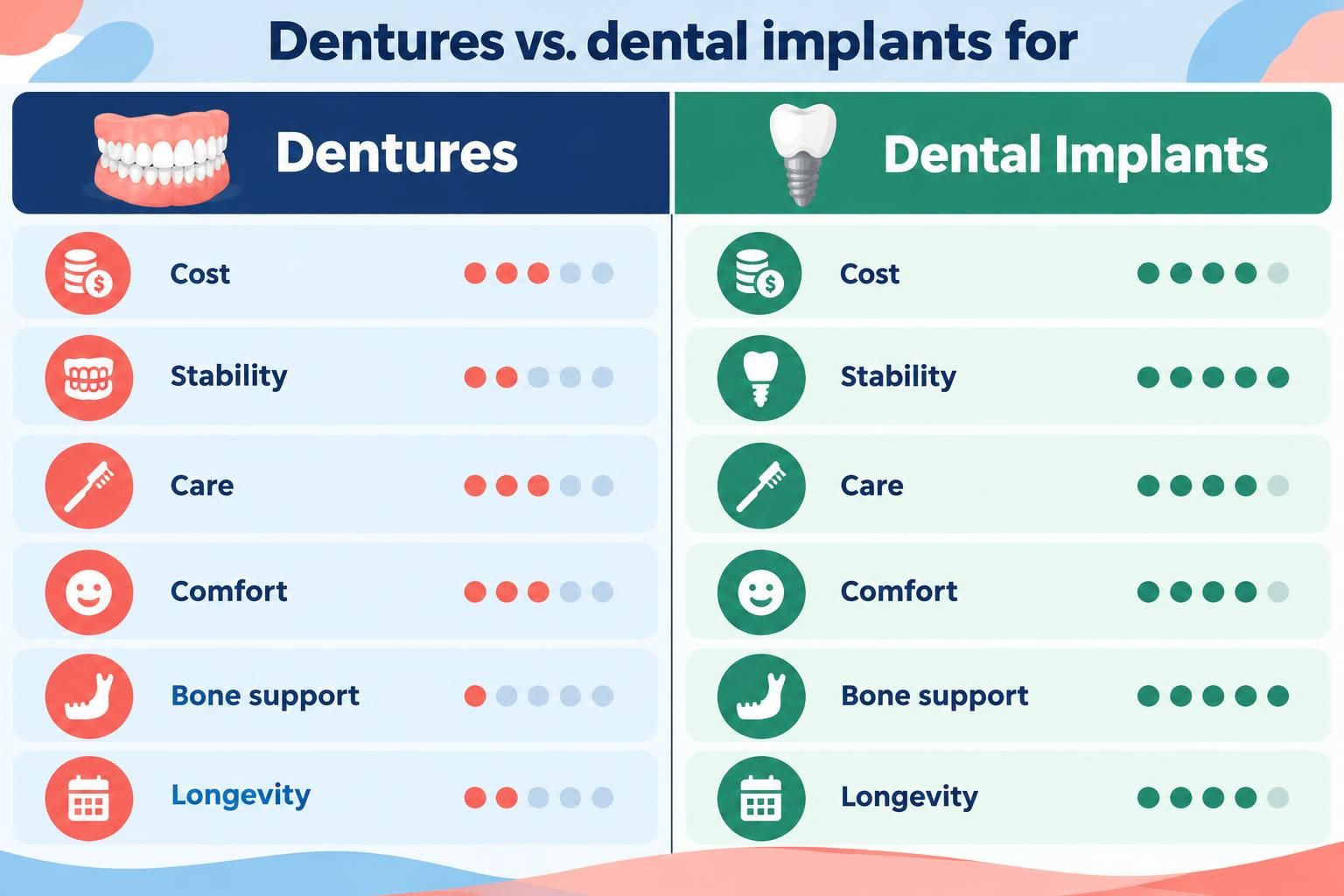
If your health supports surgery and the budget works, dental implants usually provide stronger long-term function. A dental implant uses a titanium post, or sometimes a zirconia implant, anchored in the jawbone and restored with an abutment and crown, bridge, or full-arch restoration. Because it is supported by bone rather than resting on the gums, it usually feels more secure during meals and conversation.
Dentures still have a place. A removable denture may be right if you want a faster, lower-cost, non-surgical solution or if medical risks make implant surgery a poor choice. A partial denture can replace several missing teeth without preparing adjacent teeth. A fixed bridge may work for a short span of missing teeth if the neighboring teeth are strong enough.
| Situation | Better fit | Why | Watch-outs |
|---|---|---|---|
| One missing tooth | Dental implant | Preserves nearby teeth | Needs enough bone and healing time |
| Several missing teeth | Implants or fixed bridge | Better stability than a partial denture | Cost and bite forces matter |
| All teeth missing | Implant-supported full arch | Best stability and chewing | Surgery, cleaning, and planning are bigger |
| Surgery not ideal | Removable denture | Faster and non-surgical | May move, rub, or reduce chewing power |
These are planning ranges, not guaranteed quotes. They reflect common provider and package patterns, and readers should verify current pricing, scope, deliverables, and market conditions before purchase.
These are planning ranges, not guaranteed quotes. Verify current pricing, scope, deliverables, and market conditions before purchase.
For a healthy 70- or 80-year-old who wants stronger chewing and fewer movement issues, implants often win. For someone with uncontrolled health problems, limited bone support, or difficulty maintaining implants, dentures may be safer and more practical.
Comfort also differs. Dentures can press on gum tissue and loosen as the jawbone changes over time, affecting speech and food choices. Implants are more stable, but they are not maintenance-free. You still need excellent oral hygiene, cleaning around implant restorations, and regular dental visits to help lower the risk of peri-implantitis and protect the result.
Costs, Insurance, and Medicare Questions
Implants usually cost more upfront than dentures, but the “price of an implant” isn’t one single line item. A treatment plan may include the titanium post or zirconia implant, abutment, crown, imaging, extractions, temporary restoration, sedation dentistry, bone graft, sinus lift, and follow-up visits. Full-arch restoration with All-on-4 or All-on-6 is priced very differently from replacing one tooth with one dental implant and crown.
- How many teeth are being replaced: single tooth, multiple teeth, or a full arch.
- Whether you need preparatory work, such as periodontal disease treatment, a bone graft, or a sinus lift.
- The type of final restoration: implant crown, fixed bridge, implant-supported denture, or full-arch fixed teeth.
- Who is involved in treatment: general dentist, oral surgeon, periodontist, or prosthodontist.
- The materials used and whether temporary teeth are needed during healing.
Dental insurance may help with certain parts of treatment, but coverage is often limited. Some plans contribute toward extractions, crowns, dentures, or diagnostic imaging while excluding the implant surgery itself. Others have waiting periods, annual maximums, missing-tooth clauses, or replacement-frequency limits that reduce the real benefit.
Medicare is the big question for many seniors. Original Medicare typically doesn’t cover routine dental implants, dentures, or most dental care. It may cover dental-related services only in limited medical situations, such as care tied to a covered hospital procedure. Some Medicare Advantage plans include dental benefits, but implant coverage varies widely and may have caps, network rules, or prior authorization requirements.
Before comparing options, ask for a written plan that separates surgical, restorative, imaging, anesthesia, and maintenance fees. Then confirm current costs directly with the provider and verify benefits with your dental insurance or Medicare Advantage plan. That’s the only reliable way to compare dentures, partial dentures, fixed bridges, and implant options on real numbers rather than assumptions.
What to Expect During the Implant Process
The implant process usually starts with diagnostics, not surgery. Your dentist, oral surgeon, periodontist, or prosthodontist will review your medical history, medications, bite, gum condition, and imaging. A panoramic X-ray may show the big picture, but a cone beam CT scan is often used to measure jawbone height, width, nerve position, and sinus location.
- Planning and clearance: If you take blood thinners, immunosuppressants, or have diabetes, heart disease, osteoporosis, dry mouth, or bruxism, your provider may request medical clearance or adjust the timing of treatment. Active periodontal disease or gingivitis usually needs treatment first.
- Site preparation: Some people can place the implant right away. Others need a bone graft to rebuild thin jawbone, or a sinus lift for upper back teeth when the sinus sits too low. Bone loss doesn’t always rule out implants, but it can add time and cost.
- Implant placement: Under local anesthesia, and sometimes sedation dentistry, the dentist places the dental implant, often a titanium post, into the jawbone. Zirconia implants may be considered in select cases.
- Healing period: Osseointegration typically takes a few months, though timing varies by health, bone density, grafting, and whether a temporary restoration is used.
- Final restoration: Once stable, an abutment connects the implant to the crown, bridge, or full-arch restoration.
After surgery, expect soreness, swelling, and diet changes for several days. Long term, success depends on maintenance: oral hygiene, flossing or a water flosser, regular cleanings, and early treatment if peri-implantitis signs appear.
There isn’t a fixed age limit for dental implants. What matters more is whether your mouth and overall health can support predictable healing.
If you’re comparing implants with dentures, partials, or full-arch options, don’t guess based on age alone. Schedule a consultation so a dentist or oral surgeon can review your health history, medications, gum condition, bite, and 3D imaging, then explain whether implants are appropriate now, should be delayed, or whether another option would fit better.