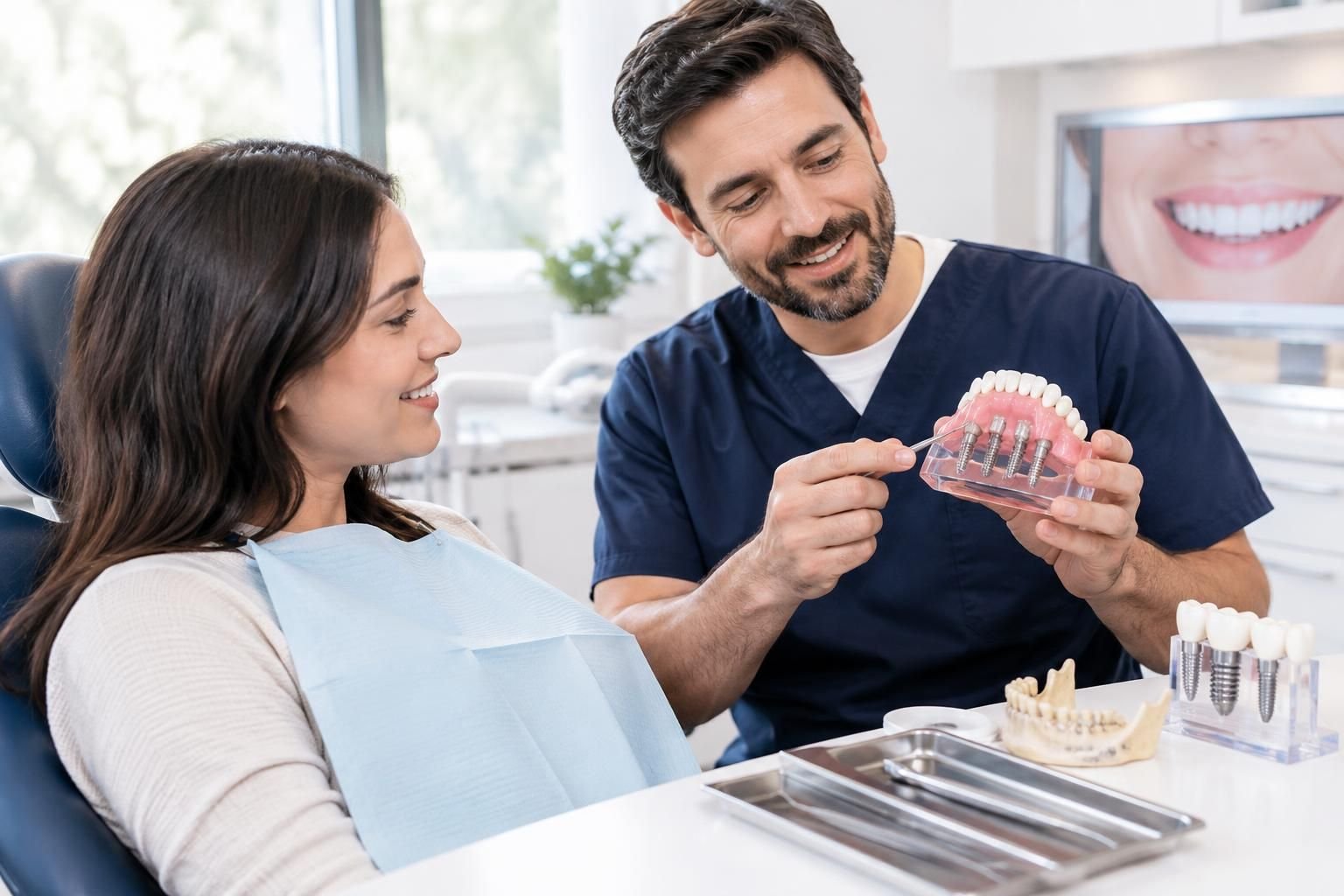
3 on 8 dental implants are a full-arch tooth replacement approach that uses eight implants to support three connected bridge sections. Instead of talking vaguely about “full-mouth implants,” this protocol describes a specific structure: implant fixtures placed across the arch, abutments attached to them, and a screw-retained restoration secured on top. It may be used for the upper arch, lower arch, or both, depending on tooth loss, bone quality, bite force, and treatment goals. If you're comparing dentures, All-on-4, 3 on 6, and other implant options, this guide will help you understand where 3 on 8 fits.
Best for: Patients who want fixed full-arch teeth and have enough bone volume for broader implant support. Not ideal when: Active gum disease, heavy smoking, or uncontrolled medical conditions make healing and implant stability less predictable. Good first step if: You're comparing full-arch options and need CBCT imaging, bite evaluation, and a restorative plan. Call a pro if: You have swelling, severe pain, loose implants, fever, or bleeding that doesn't improve after surgery.
What 3 on 8 Dental Implants Are
3 on 8 dental implants are a fixed full-arch restoration supported by eight dental implants and usually divided into three bridge segments. The segments replace all teeth in one arch while spreading chewing forces across more implant points than some streamlined protocols.
Each implant fixture is placed in the jawbone, then connected to an abutment and a bridge. Many final restorations use a screw-retained zirconia bridge or another durable material for maintenance access. For a quick refresher, implant parts and purpose helps clarify the basic structure.
How the 3 on 8 Full-arch Protocol Works
The 3 on 8 protocol works by planning implant positions across the arch, placing eight implants, and attaching temporary or final teeth once stability and healing allow. The process starts with an exam, health history, and 3D imaging to evaluate bone, sinus anatomy, and nerve position.
Some patients need extractions, bone grafting, or a sinus lift before or during implant placement.
Implant Placement and Bridge Support
Eight implants per arch give the restoration multiple support points, which can help distribute bite force and reduce stress on individual implants. The bridge is typically planned around the patient’s occlusion, smile line, available restorative space, and hygiene access.
Temporary vs Final Restoration
A temporary bridge is made for the healing period, not for lifetime function. It lets you leave with teeth in many cases, but you'll usually eat a modified diet while osseointegration happens. The final prosthesis is stronger, more polished, and adjusted for long-term bite function.

Who is a Good Candidate for 3 on 8 Implants?
A good candidate for 3 on 8 implants has significant tooth loss or failing teeth, stable oral health, and enough bone to support eight implants in the planned arch. Evaluation also looks at gum disease, diabetes control, smoking, grinding, medications, and hygiene habits.
Before treatment, ask focused implant consultation questions about grafting, temporary teeth, material choices, and who handles complications.
3 on 8 vs Other Full-mouth Options
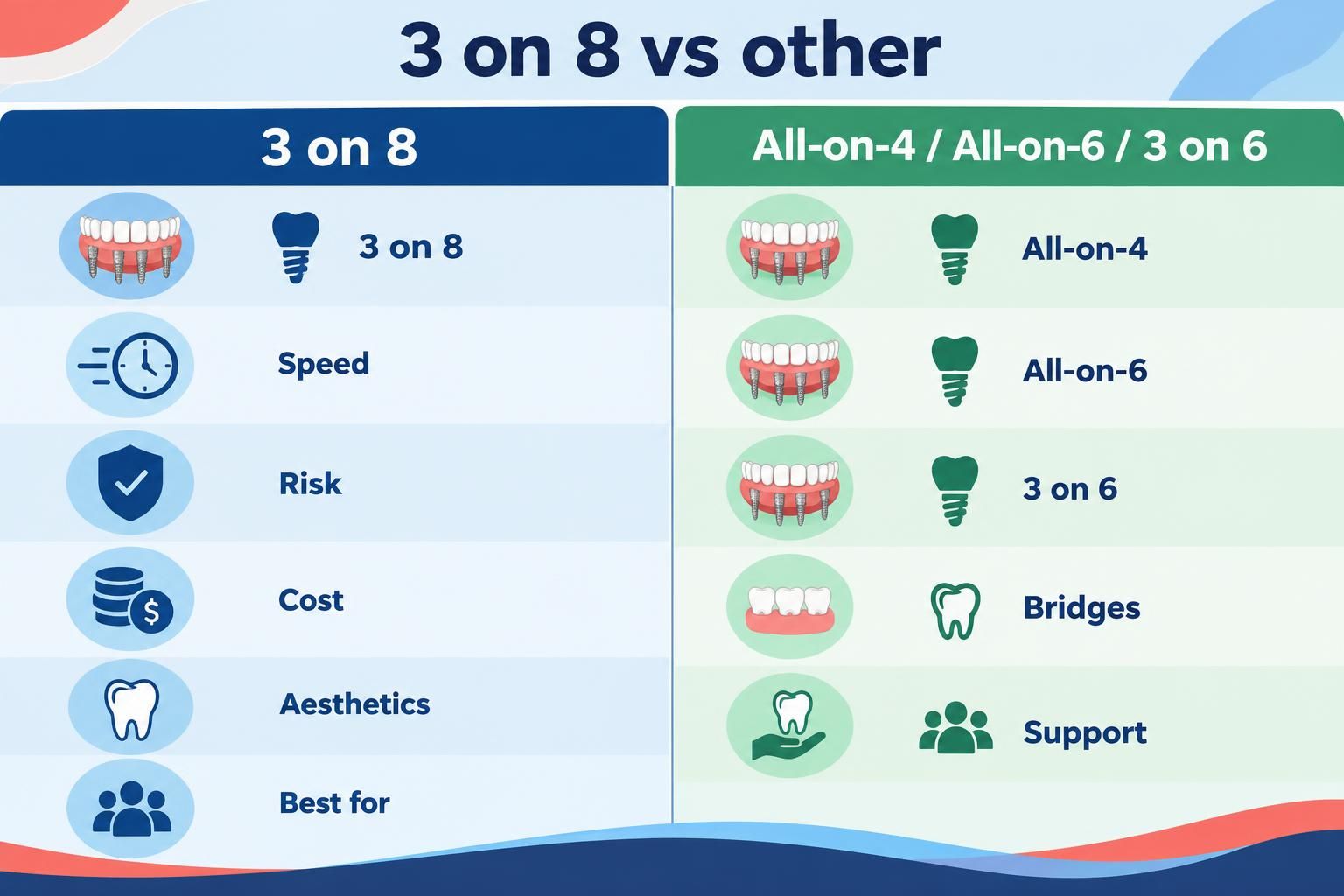
3 on 8 differs from other full-mouth options mainly in implant count, bridge design, maintenance access, and treatment complexity. It may provide more support than fewer-implant approaches, but that doesn't automatically make it the best choice for every mouth.
| Option | Implant support | Stability | Maintenance | Best fit |
|---|---|---|---|---|
| Dentures | No fixed implants | Lowest fixed stability | Removed daily | Budget-conscious or non-surgical cases |
| Implant-supported denture | Few implants with removable prosthesis | Better than dentures | Removed for cleaning | Patients wanting improved retention |
| All-on-4 or All-on-6 | Four or six implants | Fixed and stable | Professional maintenance needed | Efficient full-arch replacement |
| 3 on 8 | Eight implants with three bridge sections | Broad fixed support | Detailed hygiene required | Patients wanting segmented fixed support |
So which is better? If bone is limited, All-on-4 may avoid grafting in some cases. If you want fixed teeth but easier repair in sections, 3 on 8 can be appealing. If surgery isn't realistic, dentures may still be the practical choice.
All-on-4 and All-on-6
All-on-4 uses fewer implants and often relies on strategic angulation to support a full arch. All-on-6 adds more support points. Compared with both, 3 on 8 may offer broader distribution, but it may also require more available bone and more detailed surgical planning.
3 on 6 and Implant-supported Bridges
3 on 6 dental implants usually refer to three bridge sections supported by six implants, while 3 on 8 uses eight. Both are fixed concepts, unlike removable implant-supported dentures. The right choice depends on bone, bite force, desired stability, and how your dentist plans future maintenance.
Benefits, Limitations, and Success Factors
The main benefit of 3 on 8 is fixed full-arch function with support spread across several implants and bridge sections. Limits include grafting, sinus lifts, extractions, or staged healing. Risks include peri-implantitis, implant failure, screw loosening, material wear, and bite overload. Success depends on healthy gums, good planning, controlled occlusion, and consistent home care.
Common issues to discuss include:
- Smoking and delayed healing
- Poor oral hygiene around the bridge
- Uncontrolled diabetes or inflammatory conditions
- Grinding without a night guard
- Missed follow-up visits
- Food trapping under the prosthesis
Cost, Insurance, and Financing Basics
The cost of 3 on 8 dental implants depends on imaging, extractions, grafting, materials, sedation, lab work, and whether one or both arches are treated. Online numbers are only general planning context, not a quote.
Insurance may cover parts of treatment, but many plans limit implant or full-arch benefits. Financing, phased treatment, and health savings accounts may help with budgeting. If you are comparing options, single tooth vs. multiple tooth implant can clarify cost categories.
Treatment Timeline, Recovery, and Maintenance
The treatment timeline usually includes consultation, imaging, planning, extractions if needed, implant placement, a temporary bridge, healing, and a final bridge. Some patients receive temporary teeth quickly, while others need staged treatment.
During early recovery, you will usually avoid hard, crunchy, sticky, and chewy foods that could overload the implants or temporary bridge. If you are traveling for treatment, ask how follow-up visits, repairs, and emergencies will be handled.
Healing Milestones and Follow-up Care
Healing centers on osseointegration, the process where bone stabilizes around the titanium dental implant. Your dentist will monitor tissue healing, implant stability, bite pressure, and comfort. A general implant healing timeline can help you understand why final teeth aren't always placed immediately.
Long-term Hygiene and Replacement Considerations
Long-term care requires daily cleaning under and around the bridge with tools such as a water flosser, interdental brush, and specialty floss. Professional maintenance is still necessary, and parts of the prosthesis may need repair or replacement over time. Practical cleaning around implants habits reduce the risk of inflammation.
Common Questions About 3 on 8 Dental Implants
Common questions about 3 on 8 dental implants usually focus on cost, same-day teeth, insurance, and whether they're better than dentures or other implant protocols. The short answer is that they can be excellent for the right patient, but the “right” option depends on anatomy and goals.
Are 3 on 8 Implants Better Than Dentures?
They’re usually more stable than conventional dentures because they're fixed to implants, not resting only on the gums. But dentures may still make sense for patients who want a lower-surgery option, have medical limitations, or aren't ready for full-arch implant treatment.
Do You Always Get Temporary Teeth the Same Day?
Not always. Same-day temporary teeth depend on implant stability, bone quality, infection control, and bite conditions. Some patients wear a temporary bridge after surgery, while others need staged healing before a fixed provisional restoration is safe.
What is the Number One Reason Implants Fail?
There isn't one universal reason in every case, but inflammation around implants, poor hygiene, smoking, overload from bite forces, and untreated gum disease are common contributors. Warning signs such as swelling, drainage, mobility, or increasing pain should be discussed quickly.
How Long Do 3 on 8 Implants Last?
Longevity depends on implant integration, oral hygiene, bite control, material wear, health changes, and maintenance visits. The implants and bridge should be considered separately: implant fixtures may remain stable while prosthetic parts need adjustment, repair, or replacement.
3 on 8 can be a strong full-arch option when you want fixed teeth, have enough bone support, and are ready for the hygiene and follow-up implant bridges require.